Fire safety in vast, open spaces isn’t as simple as installing a few smoke detectors and calling it a day. That’s where Beam Detectors step in – specialized guardians of high ceilings and sprawling interiors. These devices rely on precision light beams to detect potential fire hazards before things spiral out of control. In this guide, we’re looking into the technology, how it works, and what the UAE Fire Code has to say about keeping your setup compliant.
How Do Beam Detectors Work?
Beam detectors operate based on light obscuration, meaning they detect the reduction of light intensity caused by smoke or an obstruction:
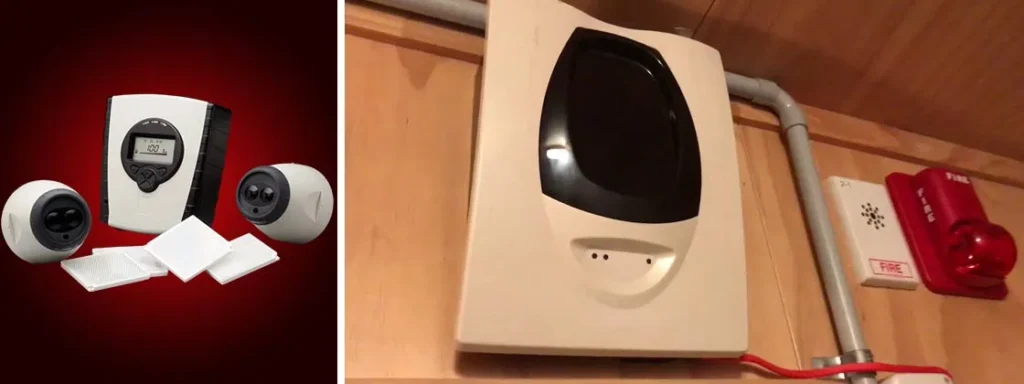
- A transmitter sends a continuous or pulsed beam of light across an open area.
- A receiver or reflector positioned at the opposite end monitors the intensity of the light.
- If smoke or another object interrupts the beam, the reduction in received light is analysed.
- If the light reduction surpasses a set threshold, the system triggers an alarm.
Some advanced models compensate for environmental factors like dust accumulation and gradual alignment shifts, reducing false alarms and maintenance needs.
Types of Beam Detectors
1. End-to-End (Transmitter-Receiver Type)
- A separate transmitter and receiver are installed at opposite ends of the monitored area.
- Ensures high reliability as it does not rely on reflected signals.
- Best for large coverage areas and long distances (can span up to 100 meters).
2. Reflective (Transmitter-Reflector Type)
- The transmitter and receiver are combined into a single unit, with a separate reflector placed at the opposite end.
- The beam is emitted, reflected, and analysed.
- Easier to install since only one powered unit is needed.
- More susceptible to environmental interference like dust and misalignment.
UAE Fire Code Regulations for Beam Detectors
The UAE Fire and Life Safety Code of Practice mandates strict compliance with installation, spacing, and maintenance standards, aligning with Dubai Civil Defense (DCD) and Sharjah Civil Defense (SCDA) guidelines.
1. Installation Guidelines
- Install per manufacturer specifications to prevent misalignment and false alarms.
- Mount detectors horizontally across open spaces with minimal obstructions.
- Consider air movement, temperature variations, and stratification when determining installation height.
- Secure mounting is essential to avoid beam misalignment due to building vibrations.
2. Spacing & Coverage Guidelines
Proper spacing ensures optimal smoke detection and minimizes blind spots. According to the UAE Fire Code and NFPA 72:
| Ceiling Type | Maximum Detector Spacing |
| Smooth Ceilings | 18.3 meters apart |
| Beamed Ceilings | Reduce spacing by 50% |
| Sloped Ceilings | Follow NFPA 72 guidelines |
| Sidewall Distance | Half the spacing distance |
Note – For ceilings higher than 10 meters, multi-level beam detection improves effectiveness.
3. Environmental & Obstruction Considerations
- Avoid placing detectors near air vents, skylights, or HVAC outlets that disrupt smoke movement.
- Maintain a clear beam path, free from structural elements like beams, columns, or racks.
- Reflective beam detectors should not be near highly reflective surfaces like glass or polished metal, as reflections may lead to false readings.
4. Alarm Sensitivity & False Alarm Prevention
- Beam detectors should have adjustable sensitivity to minimize false alarms from dust, insects, or light interference.
- Advanced models feature automatic compensation for dust accumulation and gradual alignment shifts.
- If a sudden obstruction (e.g., a bird or forklift) blocks the beam, the system should generate a trouble signal instead of an immediate alarm.
5. Testing & Maintenance Requirements
- Monthly alignment checks to confirm the transmitter and receiver remain correctly positioned.
- Quarterly testing with artificial smoke or obscuration filters to verify alarm activation.
- Annual inspection of power supply connections, wiring integrity, and environmental conditions.
Why Use Beam Detectors?
- Perfect for Large Spaces – Ideal for warehouses, shopping malls, airports, and atriums.
- Cost-Effective – Covers wide areas with fewer units, reducing installation and maintenance costs.
- Minimal Wiring – Reflector-based models require power for only one unit.
Effective in High Ceilings – Provides reliable smoke detection where traditional detectors fail.